
Hashimoto’s: What Your Doctor May Be Missing

What if you're taking thyroid medication—but you're still exhausted?
What if your TSH is “normal,” but you still have brain fog, constipation, weight changes, thinning hair, or feel cold all the time?
And what if you're in your 40s or 50s and can't tell whether what you're experiencing is Hashimoto’s, perimenopause, chronic stress, or some combination of all three?
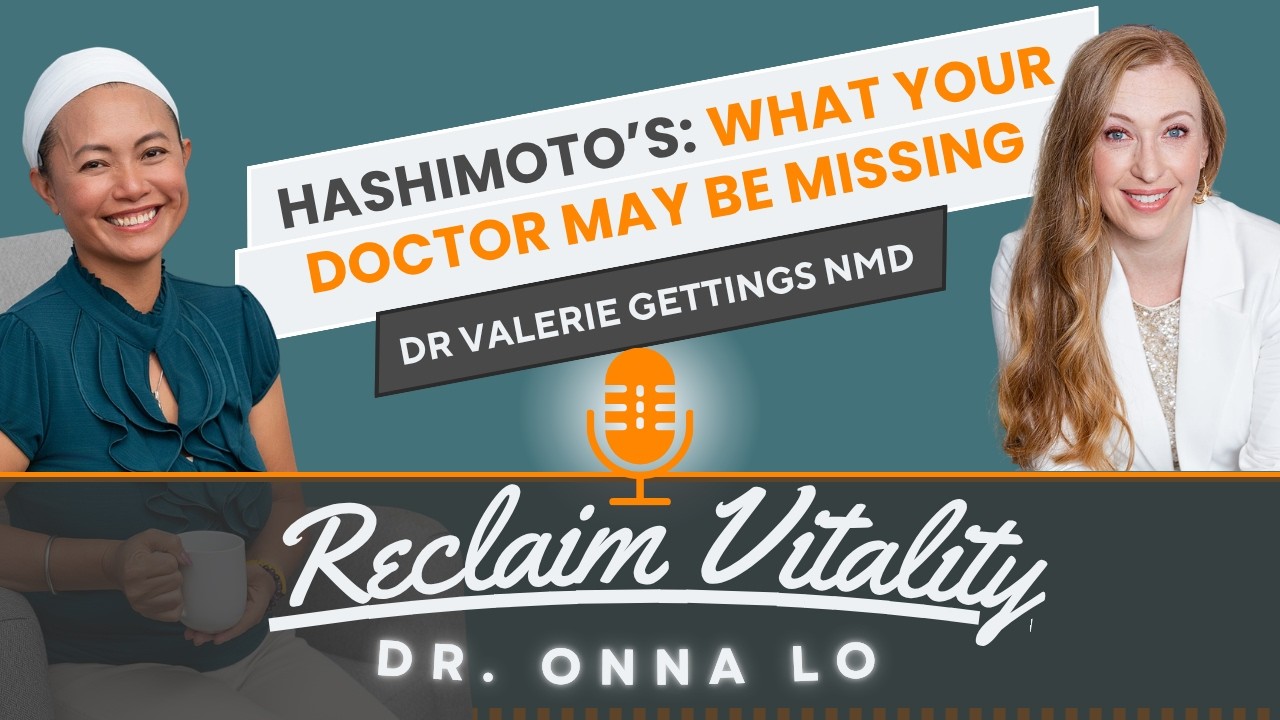
These are the questions at the center of my latest Reclaim Vitality conversation with naturopathic physician Dr. Valerie Gettings.
Hashimoto’s is the most common autoimmune cause of an underactive thyroid, but our conversation goes beyond the thyroid itself.
Together, we explore how thyroid function may intersect with autoimmunity, gut health, chronic stress, metabolism, iodine, infections, and the hormonal changes of midlife. Because sometimes the more useful question isn't simply:
“Is my thyroid normal?” It's: “Why don't I feel like myself?”
In This Episode, We Answer Questions Like:
- What is the difference between Hashimoto’s and hypothyroidism?
- Can you have Hashimoto’s even if your TSH and other thyroid labs appear normal?
- Which thyroid antibodies can help identify Hashimoto’s?
- Why might you still feel exhausted even after starting thyroid medication?
- What does gut health have to do with the thyroid and autoimmunity?
- What are the possible connections between Hashimoto’s, H. pylori, and Epstein-Barr virus?
- Can too much iodine be a problem for someone with Hashimoto’s?
- How can chronic stress and burnout affect the larger thyroid picture?
- Why can perimenopause and thyroid symptoms be so difficult to tell apart?
- What do blood sugar, insulin resistance, eating patterns, and metabolic health have to do with Hashimoto’s?
- If you have Hashimoto’s and feel overwhelmed by everything you're supposed to “fix,” where do you actually start?
Why Hashimoto’s Can Be More Than a Thyroid Problem
One of the key ideas we talked about is that Hashimoto’s is an autoimmune condition, not simply a low thyroid number.
Instead of looking only at thyroid hormone levels, we can consider what else is happening in the body.
We talk about thyroid antibodies, including anti-TPO and anti-thyroglobulin antibodies, as well as a broader thyroid panel.
We also explore when someone's history might lead us to consider other areas such as gut health, H. pylori, EBV, iodine, immune markers, or metabolic health.
That doesn't mean everyone needs every test. It means the evaluation should be guided by the person in front of us — her symptoms, history, and the questions we're trying to answer.
Hashimoto’s, Perimenopause, and Burnout Can Look Surprisingly Similar:
- Fatigue.
- Brain fog.
- Weight changes.
- Constipation.
- Dry skin.
- Changes in hair.
- Feeling cold.
- Not feeling like yourself.
Many of these symptoms can appear with thyroid dysfunction. But women entering perimenopause may experience overlapping changes in energy, cognition, sleep, body temperature, digestion, and metabolism.
Then chronic stress enters the picture.
In our conversation, we talked about the woman who is working constantly, skipping meals, sleeping poorly, caring for everyone around her, and continuing to push through exhaustion.
At that point, separating the thyroid from hormones, metabolism, gut health, and stress becomes much more difficult.
I use the analogy of an orchestra.
Your thyroid is one section. Your reproductive hormones are another. Your gut, metabolism, blood sugar, and stress response are part of the same performance.
Sometimes we need to listen to the whole orchestra rather than focusing on one instrument.
Key Takeaways From Our Hashimoto’s Conversation
If you don't have time to watch the entire conversation yet, these are some of the ideas we want women to understand:
- Hashimoto’s and hypothyroidism aren't exactly the same thing. Hashimoto’s is an autoimmune process that can eventually affect thyroid hormone production.
- A “normal” TSH doesn't always end the conversation. Symptoms, history, thyroid antibodies, and the broader clinical picture can provide additional information.
- The thyroid doesn't function in isolation. We discuss connections with the gut, immune system, chronic stress, metabolic health, and midlife hormonal changes.
- More supplementation isn't automatically better. We specifically discuss iodine and why individualized evaluation matters.
- Thyroid medication can be important without necessarily answering every question. If your numbers improve but you still feel poorly, it may be worth asking what else could be contributing.
- Midlife makes the picture more complex. Perimenopause, burnout, and thyroid dysfunction can produce overlapping symptoms, which is why looking at the whole person matters.
- You don't need to fix everything at once. Movement, strength training, adequate protein, hydration, sleep, stable eating patterns, and stress recovery remain important foundations while you determine whether further evaluation is appropriate.
What If You're Still Exhausted Despite “Normal” Thyroid Labs?
So many women know that something has changed. They may have been diagnosed with Hashimoto’s and started medication. Or perhaps they've repeatedly been told that their thyroid looks fine.
Yet they still wake up exhausted, struggle to think clearly, their body doesn't respond the way it used to, and they don't quite feel like themselves.
Those symptoms deserve curiosity.
Sometimes the next step is simply asking "What else may be happening in the body?"
Watch the Full Reclaim Vitality Episode
If you have Hashimoto’s, persistent fatigue, brain fog, unexplained weight changes, digestive symptoms, or you're trying to understand whether what you're experiencing is related to your thyroid, perimenopause, or chronic stress, I invite you to watch this episode of Reclaim Vitality.
Dr. Valerie Gettings and I go deeper into the thyroid tests we consider, Hashimoto’s and autoimmunity, gut health, H. pylori, EBV, iodine, metabolic health, intermittent fasting, chronic stress, perimenopause, and what women can consider beyond thyroid medication.
Most importantly, we talk about how to look at these pieces without becoming overwhelmed by them.
Frequently Asked Questions
1. Can you have Hashimoto’s with a normal TSH?
Hashimoto’s is an autoimmune condition involving antibodies against the thyroid. In our podcast, we discuss why thyroid antibodies and the broader clinical picture may provide useful information even when standard thyroid markers have not fully explained a woman's symptoms.
2. What are common Hashimoto’s symptoms in women?
Symptoms discussed in the episode include fatigue, brain fog, weight gain, constipation, cold intolerance, joint aches, dry skin, and thinning or brittle hair. Many of these symptoms can overlap with perimenopause and chronic stress.
3. What does gut health have to do with Hashimoto’s?
The gut-thyroid connection is an important part of our conversation. We discuss dysbiosis, intestinal permeability, H. pylori, and why digestive and immune health may be worth considering as part of the larger Hashimoto’s picture.
4. What can I do for Hashimoto’s besides taking thyroid medication?
Thyroid medication can be important when needed, but our conversation also looks at the broader picture. We discuss movement and strength training, protein, regular eating patterns, hydration, sleep, stress, metabolic health, gut health, and when further evaluation may be appropriate.
Next Step: Ready to Feel Like Yourself Again?
This post is written by Dr. Onna Lo, MD—Ivy League-trained, board-certified Family Medicine, Integrative, and Functional Medicine physician. Through my signature program, Vitality Renew, I help high-achieving women break free from exhaustion, stubborn weight, and hormonal chaos—without shame, restrictive diets, or quick fixes.
I believe you shouldn’t have to settle for feeling “just okay.” Your metabolism, hormones, and energy are meant to help you thrive—not hold you back.
If you’re ready to stop surviving and start thriving, our Vitality Renew Method Programs are here to guide you. We help you reset your hormones, restore your metabolism, and finally feel at home in your body again—without extreme diets or burnout workouts.
Your health won’t wait—why should you?
Let’s get to the root of what’s getting you stuck.

Get actionable tips delivered to your inbox so you can start using right away to feel more energized and improve your overall health.
References:
1. 1. Li J, Huang Q, Sun S, et al. Thyroid antibodies in Hashimoto’s thyroiditis patients are positively associated with inflammation and multiple symptoms. Scientific Reports. 2024.
2. Sarandi E, Tsoukalas D, Rudofsky G, et al. Identifying the metabolic profile of Hashimoto’s thyroiditis from the METHAP clinical study. Scientific Reports. 2025.
3. Zhang H, Tong W, Zeng W, et al. Persistent Symptoms in Euthyroid Hashimoto's Thyroiditis: Current Hypotheses and Emerging Management Strategies. Frontiers in Endocrinology. 2025.
4.. Cayres LCF, de Salis LVV, Rodrigues GSP, et al. Detection of Alterations in the Gut Microbiota and Intestinal Permeability in Patients With Hashimoto Thyroiditis. Frontiers in Immunology. 2021.
Disclaimer:
This information is for educational purposes only and is not intended as medical advice. Consult a qualified healthcare professional before making any health-related decisions. Individual results may vary.